Group visits
Bring a group to the museum
Clubs, schools, historical societies and social groups are welcome by arrangement — £2 per head, up to 20 people, with two weeks' notice.
Book a group visitOne of the great British conductors of the twentieth century — the man who gave the first performance of Holst's The Planets — made his professional conducting debut at West Kirby Public Hall in 1914.
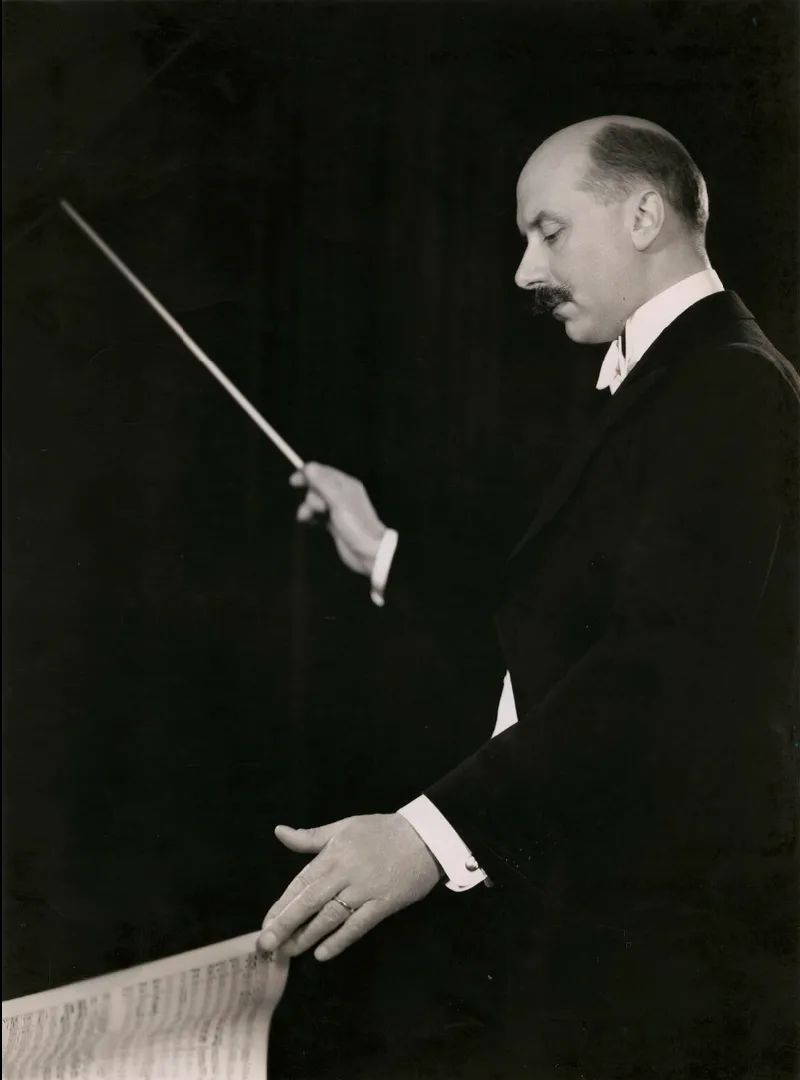
Adrian Cedric Boult was born in Chester on 8 April 1889. His father, Cedric Boult, was a businessman in Liverpool shipping and the oil trade, and when Adrian was two the family moved to Blundellsands, just north of Liverpool. He grew up hearing concerts in the city, many of them conducted by Hans Richter.
After Westminster School, Christ Church, Oxford, and a year at the Leipzig Conservatory in 1912–13, Boult returned to the north-west to begin his career. He made his debut as a professional conductor on 27 February 1914 at West Kirby Public Hall, with members of the Liverpool Philharmonic Orchestra. His programme mixed orchestral works by Bach, Butterworth, Mozart, Schumann, Wagner and Hugo Wolf with arias by Mozart and Verdi, sung by the soprano Agnes Nicholls.
On 29 September 1918, Boult conducted the first performance of Gustav Holst's The Planets. In 1930 he became the BBC's director of music, and founded and led the BBC Symphony Orchestra, conducting its first full concert on 22 October that year. He was knighted in 1937, was chief conductor of the London Philharmonic Orchestra from 1950 to 1957, and was made a Companion of Honour in 1969.
Boult died in London on 22 February 1983, aged 93.
Plan ahead
Group visits
Clubs, schools, historical societies and social groups are welcome by arrangement — £2 per head, up to 20 people, with two weeks' notice.
Book a group visitResearch Group
Our Research Group holds decades of local material — including records of who lived and worked in individual houses and shops across the village. Genuine enquiries are welcome.
Contact the Research Group