West Kirby's name, its earliest archaeology, and its best-known object all point the same way: this was a Viking-age settlement, founded by Norse settlers on the Dee estuary more than a thousand years ago.
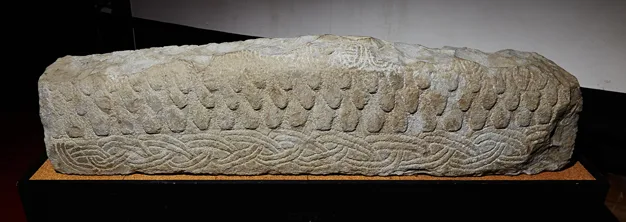
The St Bridget's hogback stone, Anglo-Norse, 10th century
A name written in Old Norse
West Kirby's name is not English but Norse. It derives from Kirkjubyr, combining Old Norse kirkja (church) with byr (farm or settlement) — literally, “the village with a church.” It is a Scandinavian place-name laid directly onto the Wirral landscape, one of a cluster of Norse names across the peninsula (Frankby, Greasby, Irby, Pensby, Raby among them) that mark out this corner of Cheshire as unusually Norse in character for England.
The “West” was added to distinguish this kirkjuby from Wirral's other one: Kirkby-in-Walea, which became modern Wallasey. The earliest documented form of the name, “West Kyrkeby in Wirhale,” appears in a record from 1285 — already showing the distinguishing “West” nearly four centuries after the Norse settlement itself.
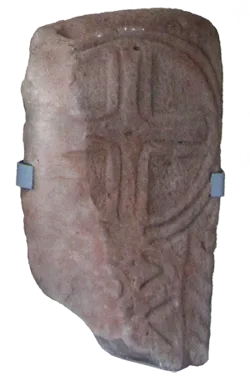
A 10th-century cross fragment, one of two surviving from the earliest church on this site
c.902 AD
Ingimund's settlement
Medieval Irish chronicle sources describe Norwegian Vikings, expelled from Dublin, seeking land in North Wirral in the early 10th century under a leader named Ingimund. Tradition holds that they were granted land near Chester by the Mercian ruler Æthelflæd, “Lady of the Mercians,” around 902 AD — the beginning of what became a significant Norse enclave across the top of the Wirral peninsula.
Archaeology backs up the place-name evidence: Viking-age cross fragments and carved stones have been found at West Kirby, Hilbre Island, Woodchurch and Bromborough, tracing a Norse Christian community that took root here within a generation or two of first settlement.
The hogback stone
The single most important object connected with the museum is the hogback stone, still kept at St Bridget's Church rather than in the museum building itself. Discovered during the 1869 restoration of the church, it dates from the 10th century and is carved from hard grey sandstone that most likely came from the Ruabon or Cefn area of North Wales — stone brought some distance for a high-status memorial.
Hogback stones are a distinctive form of Viking-age grave monument: solid, house-shaped blocks with a curved ridge and bowed sides, carved along the flanks with a “roof-shingle” pattern that echoes the timber long-houses of Scandinavian settlers. They function as stylised houses for the dead. The type is common in Yorkshire and Cumbria — areas of dense Scandinavian settlement — but rare on the Wirral, which makes the West Kirby stone especially significant.
“The non-local type of stone underlines the exotic and elite nature of this particular memorial.”
From the museum's own catalogue notes
Its design shares close links with other northern and western English examples, and its position on the coast likely reflects West Kirby's role in Irish Sea and coastal trade during the Viking period — the same trade routes that, on the balance of place-name and documentary evidence, probably brought Ingimund's settlers here in the first place.
Frequently asked questions
What does the name West Kirby mean?
It comes from the Old Norse Kirkjubyr, meaning “church settlement” or “village with a church” — from kirkja (church) and byr (farm or settlement). “West” was added later to distinguish it from Wirral's other kirkjuby, which became Wallasey.
Who was Ingimund?
A Norse leader who, according to Irish chronicle sources, led Norwegian Vikings expelled from Dublin to settle peacefully in North Wirral around 902 AD, said to have been granted land by the Mercian ruler Æthelflæd.
Where can I see the hogback stone?
It remains in St Bridget's Church, next door to the museum. The church is typically open on weekday afternoons — see the museum's visiting information for current details.
Our Research Group holds decades of local material — including records of who lived and worked in individual houses and shops across the village. Genuine enquiries are welcome.